
Releases from Charles D. Hudson Transitional Center
Charles D. Hudson Transitional Center is a minimum-security GDC transitional center and work-release reentry facility. It is physically in Troup County, but the residents remain in a state correctional system. A transition into the community may occur through parole, sentence completion, another authorized placement, or discharge under the controlling state record.
A person leaving the center may report to the Georgia Department of Community Supervision if parole or felony probation follows. Another person may reach the Maximum Release Date without parole. The durable confirmation is the state offender and release record, not an absence from the Troup County jail list.
How to Confirm a Charles D. Hudson Release
Use identifiers from the GDC record and keep tentative dates separate from actual release status.
- Open the GDC Find an Offender page and continue to the direct offender query.
- Search by name, GDC ID, case number, age, or other available identifying details.
- Read the listed facility, status, and available date fields. Confirm that the result refers to Charles D. Hudson Transitional Center.
- If parole is involved, check the Board's TPM or parolee tools. A TPM is tentative and does not prove release.
- Use DCS for field-supervision routing after release and GDC open records for a durable state record.
The Troup County released-inmate guide explains why county jail, GDC, federal, and other-agency records cannot be treated as one shared roster.
Charles D. Hudson Records and Contact
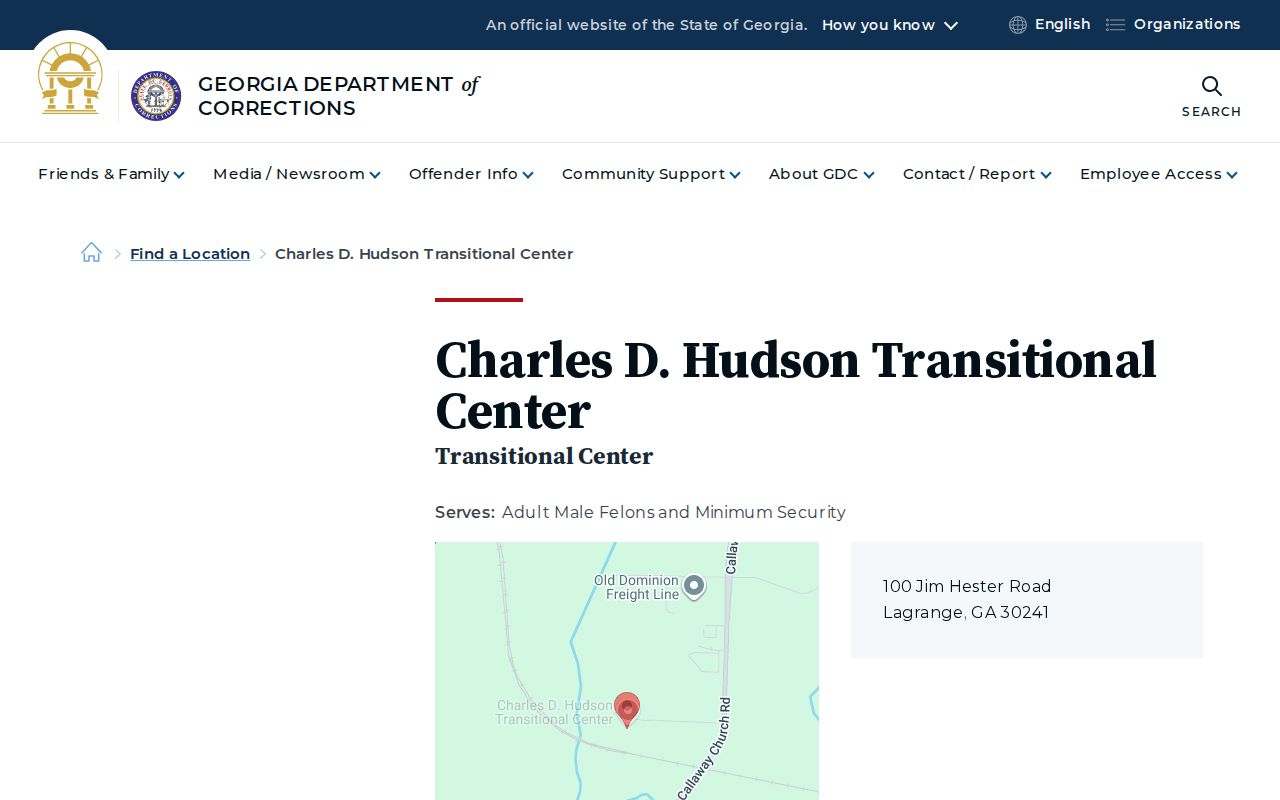
The official GDC facility page identifies the center and its LaGrange location.
Charles D. Hudson Transitional Center
100 Jim Hester Road
LaGrange, GA 30241
Georgia
Department of Corrections
Host facility: Rutledge State
Prison
Use the facility contact route for current operational questions. Use the offender query for public status and the GDC open-records portal for releasable agency documents. GDC also instructs users who need written verification to contact Inmate Records and Information at PO Box 1529, Forsyth, GA 31029.
The official location page appears below:
About Charles D. Hudson Transitional Center
GDC lists the center as minimum security with a capacity of 155. It was constructed and opened in 2003. Rutledge State Prison serves as its host facility. Its stated mission is to help residents returning to the community gain social skills and training.
Those details explain why the center is relevant to released-inmate research while remaining distinct from the Sheriff's Office jail. Hudson residents are in a structured GDC reentry program. Troup County Jail holds local detainees, people awaiting court or bond, local sentences, warrants, holds, and transfers.
Charles D. Hudson Parole and DCS Path
The State Board of Pardons and Paroles controls parole decisions for eligible Georgia prisoners. The Board's Inmate TPM Lookup may show a Tentative Parole Month, which is the month planned for final review and possible date setting. It is not a final parole decision. The Parolee Search is the better post-release route for a person actually on parole.
DCS carries out felony probation and parole supervision in the field. The DCS LaGrange office is at 220 Fort Drive, LaGrange, GA 30240, phone 678-783-4337, and lists weekday hours from 8:00 a.m. to 5:00 p.m. Contact that office for routing when the state record indicates local community supervision.
Do not confuse eligibility with release. O.C.G.A. 42-9-45 supplies general parole timing, but serious-offense statutes, mandatory minimums, repeat-offender rules, and other exceptions can change the result.
Charles D. Hudson Release Dates and PIC
GDC and parole materials may use Tentative Parole Month, Performance Incentive Credit date, and Maximum Release Date. Each label has a different function. The TPM signals a planned final-review month. The MRD reflects the sentence endpoint used in the state system.
Eligible offenders can earn up to 12 PIC points, potentially receiving 1 to 12 months off a TPM or MRD. Conduct can advance or delay the applicable date, and exclusions mean not every resident participates. The Board may also deny, postpone, cancel, or change a tentative plan before release.
For an actual release, compare the later GDC status, parolee record, DCS supervision record, and VINE status when available. A projected date is planning information, not proof that the resident left the center.
Request Charles D. Hudson Release Records
The GDC open-records portal is the correct request channel for state records. GDC cites the Georgia Open Records Act, O.C.G.A. 50-18-70 et seq., and states that it provides an initial response within three business days. Non-medical copies cost $0.10 each, while search and redaction may be billed at the hourly rate of the lowest-paid qualified employee.
Ask narrowly for the public custody and release or discharge record for the named person, including the actual date, status, and destination or supervision agency when releasable. Include a GDC ID and approximate dates if known. GDC lists exceptions for institutional files, investigations, personal information, safety procedures, and medical or mental-health records, so do not ask for protected material.
Georgia VINE can provide a custody-change alert for covered people, but it is not a complete historical archive. Preserve the alert, then obtain the official GDC record when lasting proof is needed.
Hudson Release vs Troup County Transfer
The two LaGrange facilities create a common source error. If a person leaves Troup County Jail for GDC, that local event is a transfer, not release into the community. Follow the person in GDC systems. If the destination is Charles D. Hudson, the state record controls the later reentry release.
Likewise, a Hudson resident does not become a Troup County Jail release merely because both facilities share the county. Ask each record for the release disposition or transfer destination. This prevents a county roster disappearance from being mistaken for discharge and keeps parole, DCS, federal, or other-agency custody tied to the agency that actually controls it.
Life After a Charles D. Hudson Release
GDC says money left on a resident's books after release is transferred to a Georgia release card. Its guidance provides activation and PIN steps and lists 866-777-5729 for JPay questions. That financial process is another sign that Hudson residents follow state release administration rather than the property and account process used for a county jail booking.
Community supervision, when ordered, is separate from the facility discharge. DCS may provide reporting instructions, while the Board maintains parole decision and parolee records. A person who completes a sentence without supervision does not follow the same route as a parolee. Confirm the exact status before treating the LaGrange DCS office as the required next stop.
Family members planning transportation should verify actual release with GDC and the resident rather than arrive based on a TPM or public query alone. Facility procedures and timing can change. The public record can establish status, but GDC controls operational steps, authorized pickup instructions, and the point at which the resident may leave.
Charles D. Hudson Search Fields and Verification
The Georgia.gov offender gateway explains that GDC offenders may be searched by name, ID or case number, age, and other identifying information. The direct GDC query is the appropriate database for a Hudson resident. County-jail searches are directed to county sites, which confirms that the two LaGrange facilities must not share one lookup path.
GDC photographs display automatically when available. A photograph can help distinguish similar names, but it should be compared with the GDC ID, facility, case data, and age. GDC's public disclaimer calls for written verification through Inmate Records and Information when official confirmation is needed. A search result alone may not explain every status change or planned transfer.
For future release alerts, Georgia VINE can be searched by name or ID when the person is covered. Open the matching record, confirm the agency, and register for an available app, phone, email, or text notice. A VINE change is a status signal. Preserve it, then obtain the GDC release or discharge record for durable proof.
Charles D. Hudson Records vs County Records
Troup County's JustFOIA portal is useful for Troup County records, including a local jail booking and transfer disposition. It is not the primary portal for a Hudson resident's state correctional file. Send a GDC release request to GDC so the agency that created and maintains the record can search it and apply the correct state exceptions.
If the person first appeared at Troup County Jail and then moved to Hudson, two records may be needed. The county record establishes when local custody ended and identifies the transfer destination. The later GDC record establishes state placement and eventual release, parole, or discharge. The Clerk docket may explain the sentence that authorized transfer into state custody.
The Troup arresting-agency list also includes the United States Marshals Service and other-agency holds. Those paths reinforce the same rule: leaving one local facility does not prove community release. Follow the named receiving agency until an official record shows discharge, release, or a new form of supervision.